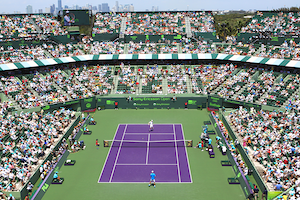


Two points was all the world number one needed to saunter into the round of 16 at the Miami Open. Instead up 6-4, 5-4 and 30-0 in the second set, Naomi Osaka donated two double faults in the game to hand her opponent a break point. Once Osaka’s backhand landed wide, the score was leveled at 5-5. Still, there were chances in the tiebreak which went unclaimed by the Japanese star. Consequently, the match was decided with a third set.
Osaka secured a 2-0 lead when Su-Wei Hsieh double faulted at 15-40. But the veteran from Chinese Taipei was not discouraged. By swarming the net, she was up 0-30. Once Osaka’s backhand landed on her side of the net, Hsieh had break point. She converted by striking a return winner. Throughout the decisive set, Osaka was under the hatchet. Many times, the world number one found herself at 0-30 on her serve. She finally paid the price in the seventh game when a couple of errors delivered the 4-3 advantage to her rival. Subsequent to consolidating for 5-3, Hsieh went back to work. She arrived at her another break point which this time was a match point. Hsieh seized the victory 4-6, 7-6, 6-3 with a volley winner.
The Japanese player had clashed with Hsieh twice before. Thus, she should have known not have counted success until the umpire calls game set and match. In essence that was what she did “I think in that moment I got ahead of myself, but all the other times it was pretty fine. Like, I knew it was going to be a tough match playing her.. . I was kind of immature today. I was thinking too much, like everything was on my racquet. Honestly, she has the ability to make winners, too, whenever she wants.”
For Osaka, being in the position of number one and being expected to always win, she admits is added pressure “I think there’s a difference between having confidence and sort of getting ahead of yourself. . . the last time I played her, she was up two breaks or something, 4-1, I don’t remember if that was one or two breaks. I was just thinking, I was in a bigger hole last time, so I should be able to dig myself out of the hole this time. I completely forgot that she also learned things from that match. It wasn’t just me that was playing there. I just think it wasn’t that I had a big head, but I think I wasn’t really thinking about all of the things that was happening”.
After the Australian Open, Osaka had a major change, parting with Sascha Bajin. This is her second tournament with new coach Jermaine Jenkins. One area which failed Osaka today was her serve as she attempted to close out her counterpart “I’ve been working on my serve a lot these last two tournaments. And definitely it’s improved from Indian Wells to here. . .I don’t think the percentage was that great today. I was slowly starting to count on it again like I used to. . .I’ve been working a lot on my second serve. I think I need to continue practicing it because she was stepping in a lot and being very aggressive. That’s not something I want people to do. . .I think it’s interesting whenever you change coaches because there’s always an adjustment time. . .I think that I played pretty good today actually, if I get over the fact that I lost. I think I played a lot of good rallies. Of course, there were some shots that I tried to hit a winner on to early. I just do that sometimes. It’s nothing to be negative about. . .I think definitely we have a lot of ideas that we need to swap, so we really need to talk about that.
2017 Miami Open finalist Caroline Wozniacki overcame the antics of mercurial Romanian Monica Niculescu 6-4, 7-6 to march on to the round of 16. She will take on Hsieh next.
Petra Kvitová outlasted Donna Vekic in a 2 hour 36 minute contest. The 2 time Wimbledon champion edged out her rival 6-4, 3-6, 6-4. In the fourth round, Kvitová will clash with Caroline Garcia who dispatched Julia Goerges 6-0, 7-5.
In the battle of the Aussie, Ashleigh Barty bounced former U.S. Open winner Samantha Stosur 6-0, 6-3. Her opponent will be Kiki Bertens. The seventh seed coasted to triumph after dropping the first set with a 3-6, 6-0, 6-1 win over Viktoria Kuzmova.
Eight-time Miami Open champion Serena Williams was forced to withdraw from the tournament due to a left knee injury.
With the withdrawal, the tournament’s No. 18 seed Qiang Wang of China advances to the fourth round.