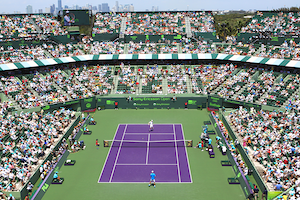


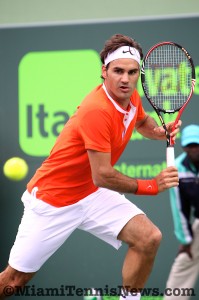
Following a first round bye, Roger Federer, a three time champion comes out for his initial match in the new home of the Miami Open. The Swiss will clash with qualifier Radu Albot in the afternoon. This will be their first encounter.
Beforehand, Federer’s countryman, 3 time Major champion Stanislas Wawrinka kicks off the day session in stadium court. Wawrinka collides with Serb Filip Krajinovic. The two have yet to play at this tour level.
The night schedule features 2013 French Open finalist David Ferrer against Alexander Zverev ranked number two. The German has prevailed in four of their prior six meetings
Other players who will be displaying their talent as they fight for a place in the third round include 2019 Australian quarterfinalist Stefanos Tsitsipas, 2 time major semifinalist Grigor Dimitrov, 2014 U.S. Open champ Marin Cilic and American hopeful Australian Open quarterfinalist Frances Tiafoe.
Here is the order of play for Saturday March 23, 2019:
STADIUM start 12:00 noon
ATP – [30] S. Wawrinka (SUI) vs F. Krajinovic (SRB)
WTA – [1] N. Osaka (JPN) vs [27] S. Hsieh (TPE)
Not Before 4:00 pm
ATP – [Q] R. Albot (MDA) vs [4] R. Federer (SUI)
Not Before 8:00 pm
ATP – [WC] D. Ferrer (ESP) vs [2] A. Zverev (GER)
Not Before 9:30 pm
WTA – B. Andreescu (CAN) vs [8] A. Kerber (GER)
GRANDSTAND start 12:00 noon
WTA – [3] P. Kvitova (CZE) vs [26] D. Vekic (CRO)
ATP – [24] G. Dimitrov (BUL) vs F. Lopez (ESP)
WTA – [Q] M. Niculescu (ROU) vs [13] C. Wozniacki (DEN)
ATP – [8] S. Tsitsipas (GRE) vs [LL] M. McDonald (USA)
Not Before 7:00 pm
WTA – A. Tomljanovic (AUS) vs [21] A. Kontaveit (EST)
COURT 1 start 11:00 am
ATP – [20] D. Shapovalov (CAN) vs [LL] D. Evans (GBR)
ATP – [6] K. Anderson (RSA) vs J. Munar (ESP)
ATP – [Q] A. Rublev (RUS) vs [9] M. Cilic (CRO)
WTA – V. Kuzmova (SVK) vs [7] K. Bertens (NED)
ATP – [28] F. Tiafoe (USA) vs [WC] M. Kecmanovic (SRB)
After Suitable Rest – [3] S. Hsieh (TPE) / B. Strycova (CZE) vs K. Christian (USA) / A. Muhammad (USA)
BUTCH BUCHHOLZ COURT start 11:00 am
WTA – [19] C. Garcia (FRA) vs [15] J. Goerges (GER)
ATP – J. Thompson (AUS) vs [10] K. Khachanov (RUS)
WTA – [12] A. Barty (AUS) vs S. Stosur (AUS)
Not Before 4:00 pm
ATP – [Q] R. Opelka (USA) vs [21] D. Schwartzman (ARG)
ATP – [3] B. Bryan (USA) / M. Bryan (USA) vs M. Fucsovics (HUN) / R. Jebavy (CZE)
COURT 2 start 11:00 am
WTA – L. Kichenok (UKR) / N. Kichenok (UKR) vs [WC] A. Anisimova (USA) / A. Riske (USA)
ATP – J. Chardy (FRA) / G. Simon (FRA) vs N. Jarry (CHI) / F. Skugor (CRO)
WTA – D. Jakupovic (SLO) / I. Khromacheva (RUS) vs [5] G. Dabrowski (CAN) / Y. Xu (CHN)
After Suitable Rest – R. Bopanna (IND) / D. Shapovalov (CAN) vs A. Krajicek (USA) / A. Sitak (NZL)
WTA – A. Rosolska (POL) / Z. Yang (CHN) vs K. Flipkens (BEL) / J. Larsson (SWE)
COURT 6 start 11:00 am
ATP – J. Sousa (POR) vs [31] S. Johnson (USA)
ATP – [13] D. Medvedev (RUS) vs A. Mannarino (FRA)
After Suitable Rest – J. Goerges (GER) / S. Halep (ROU) vs [2] T. Babos (HUN) / K. Mladenovic (FRA)
WTA – [8] H. Chan (TPE) / L. Chan (TPE) vs I. Begu (ROU) / M. Buzarnescu (ROU)
WTA – After suitable rest – [1] B. Krejcikova (CZE) / K. Siniakova (CZE) vs [WC] V. Azarenka (BLR) / A. Barty (AUS)
COURT 8 start 11:00 am
ATP – L. Mayer (ARG) vs [26] G. Pella (ARG)
ATP – P. Andujar (ESP) vs [18] D. Goffin (BEL)
ATP – [8] H. Kontinen (FIN) / J. Peers (AUS) vs R. Ram (USA) / J. Salisbury (GBR)
After Suitable Rest – G. Pella (ARG) / J. Sousa (POR) vs [WC] T. Fritz (USA) / N. Kyrgios (AUS)
After Suitable Rest – A. Groenefeld (GER) / L. Hradecka (CZE) vs M. Niculescu (ROU) / A. Spears (USA)
COURT 9 start 11:00 am
ATP – J. Rojer (NED) / H. Tecau (ROU) vs [5] O. Marach (AUT) / M. Pavic (CRO)
ATP – [14] M. Cecchinato (ITA) vs D. Dzumhur (BIH)
ATP – R. Haase (NED) / D. Inglot (GBR) vs [4] J. Cabal (COL) / R. Farah (COL)
WTA – A. Pavlyuchenkova (RUS) / A. Sevastova (LAT) vs V. Kudermetova (RUS) / D. Schuurs (NED)
After Suitable Rest – [1] L. Kubot (POL) / M. Melo (BRA) vs M. Cecchinato (ITA) / A. Molteni (ARG)

 Subsequent to taking only 24 minutes to pocket the opening set 6-0 at the Miami Open, Naomi Osaka was seriously challenged by former world number 12 and 2009 U.S. Open semifinalist Yanina Wickmayer. The Belgian fought back to seal the second set in a tiebreaker. However, in the decisive set, Osaka demonstrated the strength which garnered her the last two majors. After breaking and consolidating for a 3-0 lead, the world number one grabbed an insurance break. Later, with a crosscourt running forehand, Osaka set up triple match point. With Wickmayer’s return sailing wide, the Japanese woman secured her spot into the third round with a 6-0, 6-7, 6-1 victory. Osaka will face 27th seed Su-Hei Hsieh.













 It’s an all American ladies’ line up on Stadium court at the Miami Open on Thursday as second round action gets underway. World number 3 Karolina Pliskova opens play on center court against American Madison Brengle. Later in the afternoon, 2012 Miami Open semifinalist and former world number one Carolina Wozniacki battles another American Varvara Lepchenko. The night cap has reigning French Open champion Garbine Muguruza taking on Christina McHale. With the former Spaniard by way of Venezuela, it should be an electric evening on Miami’s main show court.

 By choosing South Florida as her base and lifting the trophy on seven prior occasions, the Miami Open is Serena Williams’ home. Consequently, this afternoon, first time finalist Carla Suarez Navarro needed to play the match of her career to steal the title from the two time defending champion. Williams romped Carla Suarez Navarro 6-2, 6-0 for a third successive Miami Open trophy, her eighth overall.

 After her second round win, Catherine Bellis was asked how she would approach an encounter with Serena Williams “it’s going to be really fun. I’m just going to play my game and see what happens. . .it’s just another opponent”. The 15 year old got the memo today that Williams is not ‘just another opponent’. The world number one required only 41 minutes to crush the youngster 6-1, 6-1 and stay on track for her eighth Miami Open title.