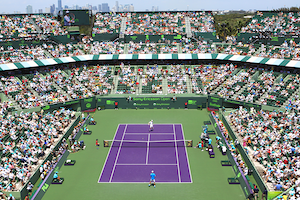


The 2019 Miami Open will break ground at its new location at the Hard Rock Stadium next month.
Today, the tournament announced the players field that will be taking to courts at the state of the art facilities in Miami Gardens. The ATP and WTA field includes a total of 19 Major singles champions.
The men’s side will be highlighted by the 2019 Australian Open champion Novak Djokovic. Joining Djokovic in Miami are the likes of Rafael Nadal, Roger Federer, Juan Martin del Potro and 2018 Miami Open champion John Isner.
The women’s side will be highlighted by the 2019 Australian Open champion Naomi Osaka. Osaka will be joined by defending Miami Open champion Sloane Stephens, Serena Williams, Simona Halep, Petra Kvitova and Caroline Wozniacki.
Here is the official press release from tournament:
Miami Gardens, FL (February 6, 2019) – The 2019 Miami Open presented by Itaú will make its debut at Hard Rock Stadium March 18-31, and fans will have the opportunity to see one of the best player fields in tennis at its new lifestyle and entertainment venue.
This year’s extraordinary lineup features 19 players who have combined to win 108 career Grand Slam singles titles including all-time record holders Roger Federer and Serena Williams. Reigning Australian Open champions, and the world’s No. 1 ranked players, Novak Djokovic and Naomi Osaka top one of the strongest ATP and WTA tournament draws of 2019.
Overall, each of the top 79 ranked men and 76 ranked women have entered to compete in Miami.
Federer and Djokovic lead a men’s field that includes 17-time Grand Slam champion Rafael Nadal, three-time Grand Slam champion Stan Wawrinka, and former US Open champions Juan Martin del Potro and Marin Cilic, along with defending Miami Open champion John Isner.
The player field also boasts the next generation of ATP stars including World No. 3 Alexander Zverev, Australian Open semifinalist Stefanos Tsitsipas, American Frances Tiafoe and Australian Nick Kyrgios.
The women’s field is even more impressive. Osaka, winner of the last two Grand Slam singles titles, leads a field that includes 23-time Grand Slam champion Serena Williams and defending Miami Open champion Sloane Stephens. Fans also will have the opportunity to see seven-time Grand Slam Champion Venus Williams, five-time Grand Slam champion Maria Sharapova, two-time Grand Slam winner Garbiñe Muguruza, two-time Grand Slam winner Angelique Kerber, two-time Wimbledon champion Petra Kvitova, reigning French Open champion Simona Halep, 2018 Australian Open champion Caroline Wozniacki and 2017 French Open champion Jelena Ostapenko.
The player field however is just part of the story.
Tournament Owner IMG and Miami Dolphins Owner Stephen Ross partnered to keep the Miami Open in Miami and have worked together to build a permanent world-class tennis facility that will provide an elevated fan experience while incorporating a unique Miami look and feel. The improved amenities will allow the tournament to host a true lifestyle and entertainment event featuring the best in tennis, art, food and music.
Tickets to the 2019 Miami Open are on sale now and available by phone at 305-943-6736 or online at www.miamiopen.com. Individual session tickets start at just $28 so get your tickets today. Ticket packages, group programs, and luxury hospitality offerings also are available.
Qualifying rounds will be March 18-19 and will determine 12 additional slots in each singles draw. The Miami Open also will award wildcards to five men and eight women. The women’s main draw begins on Tuesday, March 19, followed by the first round of the men’s main draw on Wednesday, March 20.
ATP Acceptance List (as of February 6, 2019)
Name Country Rank
Novak Djokovic, SRB, 01
Rafael Nadal, ESP, 02
Alexander Zverev, GER, 03
Juan Martin del Potro, ARG, 04
Kevin Anderson, RSA, 05
Roger Federer, SUI, 06
Kei Nishikori, JPN, 07
Dominic Thiem, AUT, 08
John Isner, USA, 09