
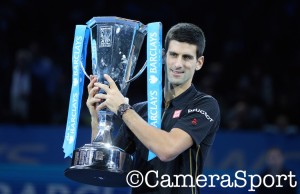
The much anticipated tussle for the Barclays ATP World Tour Finals trophy between the world’s top two players, Novak Djokovic and Roger Federer, was scrubbed due to injury. Djokovic took home a third consecutive title, his fourth overall, as Federer forfeited the match.
Approximately an hour prior to start time, a packed arena listened to Federer apologizing for his decision not to take the court. The six time year end championship titlist was forced to pull out of today’s contest because of a back problem which surfaced in the semifinals. This was only the third time since turning pro in 1998 that Federer has pulled out of a tournament he began playing and never before in a final. The withdraws from the other matches were also provoked by an unfit back.
The full stadium settled for exhibition matches which organizers scrambled to put together at the ultimate minute. Brit Andy Murray, who was ousted in the round robin round, came to the rescue by playing a set against Djokovic which the latter won. It was followed by a doubles competition featuring John McEnroe and Murray versus Pat Cash and Tim Henman.
What a difference less than twenty four hours make! On Saturday, spectators were treated to two tantalizing matches. The drama between Federer and compatriot Stanislas Wawrinka alone was worth the price of admission.
After losing the first set 4-6, Federer scrapped through the second set, breaking Wawrinka at 6-5 to push the match to a deciding set. Subsequent to breaking Federer in the opening game, Wawrinka maintained the advantage and served for his first year end final at 5-4.
With Wawrinka squandering two match points, the third set victor was determined by a tiebreaker. Once again, Federer overcame two match points prior to coming out on top.
Djokovic was also challenged in his semifinal match by Kei Nishikori, the man who shocked him in the semifinals at the U.S. Open this year. After being absent in the opening set and Djokovic seizing it 6-1, Nishikori persevered and took the second 6-3.
However, there would be no full comeback for the Japanese as Djokovic regained the reigns in the third set. The Serb dominated 6-0 to punch his ticket into the last ATP match of 2014.
With today’s triumph, Djokovic became the first player since Ivan Lendl 1985-87 to lift this trophy three years in a row.
Although the ATP season is now concluded, for Federer there is still the matter of the Davis Cup. In just a few days, Switzerland will battle France in the final. 1992 was the only other occasion that Switzerland reached this stage of the competition. That year, the United States captured the win. Consequently, should Federer hoist this distinguishing prize, he will further cement his iconic status in the sport. After all, both Rafael Nadal and Djokovic, his two biggest rivals, have at least one Davis Cup title. Then, the only milestone for the Swiss to conquer would be singles Olympic Gold.

 No room for dispute, 2010 was a banner year for Rafael Nadal. The Spaniard captured three majors, regained the world number one ranking and completed the career grand slam. As such, Nadal’s domination left no ambiguity as to who was the most outstanding player in 2010. With the year at a close, here’s a snapshot of the stories which caught the headlines this foregone season.

 Coming into today’s rubbers with a 1-2 deficit, Serbia faced a monumental challenge in trying to win its first ever Davis Cup title. Yet, with an inspired performance from Novak Djokovic and Viktor Troicki, disappointment would not be in the cards. Backed by a raucous home crowd, the Serbs carried both singles matches against France to claim their initial Davis Cup title.

 Mardy Fish and Mark Knowles fought back in the final of the Legg Mason Tennis Classic overcoming Tomas Berdych and Radek Stepanek 4-6,7-6,10-7 to bag their second title as a team.

 In the doubles semifinals in Washington, Tomas Berdych and Radek Stepanek regrouped after dropping a contested first set to edge out the fourth seed Julian Knowle and Andy Ram 5-7,6-2,10-4.

 At the Legg Mason Tennis Classic, the first semifinal showcased Marcos Baghdatis, the eighth seed, against Xavier Malisse. Baghdatis defeated Malisse 6-2,7-6 to earn his initial spot in the final of a tournament States side. Later, David Nalbandian booked his maiden berth in a final on U.S. soil by thumping fourth seed Marin Cilic 6-2,6-2.

 With the quarterfinal spots at stake, after nearly five hours, the stormy weather cleared to allow play at the Legg Mason Tennis Classic. While Tomas Berdych, the number one seed, and Fernando Verdasco, the third seed, battled their way into the next round. For the Americans, the tournament was a disaster. Andy Roddick, the three time champion and second seed, 2007 finalist John Isner as well as 2010 Atlanta champion Mardy Fish were all swept away.

 The year was 1923 the last time France carried a Davis Cup tie against Spain. Today, the Frenchmen rectified that situation as Julien Benneteau and Michael Llodra defeated Fernando Verdasco and Feliciano Lopez 6-1,6-2, 6-7,7-6 to secure the crucial third point. In so doing, France advances to the semifinals for the first time since 2004.

 In the quarterfinals of the Australian Open, defending champion and world number two, Rafael Nadal, prematurely set down his racket due to the sudden onset of a knee injury. For several seasons, the 23 year old has been afflicted with one form of physical ailment or another. After an extraordinary victory in 2008, last June, Nadal was unable to defend his title at Wimbledon due to tendonitis. As an individual who has exhibited exemplary conduct both on and off the court, there’s a noticeable void when a player of Nadal’s caliber is absent. Here are a few reasons why the game is better with Nadal.

 From Rafael Nadal winning his first hardcourt major in Australia, to Roger Federer completing the career grand slam, to the emergence of a new major star Juan Martin Del Potro at the U.S. Open, 2009 was a year replete with ups and downs on the men’s tour. Here’s a flashback.