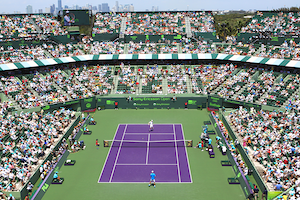
Although the familiar saying states “all good things must come to an end”, when it comes to tennis it’s not necessarily the case. While the 2010 season is over, in the blink of an eye the new one will commence. Before turning to a fresh chapter, it’s important to reminisce and ponder what made this past year noteworthy.
At her first tournament after rejoining the tour, Justine Henin was a finalist in Brisbane. The Belgian followed that result with a run to the final at the Australian Open. In a compelling match, Serena Williams edged out Henin to defend her title and claimed her twelfth career major. Despite Williams’ conquest, the road to victory was far from routine. Thus, early indications were Williams would be fighting tooth and nail to retain the number one ranking. Yet, in the end, injury became Serena’s speed bump rather than her fellow competitors.
Following Australia, a knee injury caused Williams to put her feet up for a few months. In May, a healthy Serena returned to competition. Subsequent to being stunned in the French Open quarterfinals, Williams successfully defended her Wimbledon title. However, days after her triumph, Serena suffered a freakish foot injury. Initially, the damage seemed inconsequential. But, as the weeks went by, Serena withdrew from tournament after tournament and underwent surgery. Ultimately, Wimbledon proved to be Serena’s last event of 2010.
Ironically, Serena’s similar fate befell Henin. After being booted in the round of 16 at Roland Garros, Henin turned her focus to Wimbledon the underlying reason for her comeback. With a title at a warm-up tournament before Wimbledon, Henin was a serious contender to capture the sole major which has eluded her. But, after easily carrying the first set against Kim Clijsters, Henin fell on her elbow and eventually loss in the round of 16. What at first seemed an innocuous tumble prematurely terminated Henin’s year.
After being upended in the quarterfinals at the Australian Open by Na Li, Venus Williams caught a full head of steam and defended back to back titles in Dubai and Acapulco. Then, Venus made the finals at the Sony Ericsson Open and the Mutua Madrilena Madrid Open. Consequently, Venus’ ranking peaked at number two. Days after celebrating her 30th birthday, the five time Wimbledon champion stepped on the grass with high hopes for a sixth crown. However, in the quarterfinals, Venus was sent packing by Tsvetana Pironkova. Later at the U.S. Open, Williams watched an opportunity to advance to the final evaporate, going down to Clijsters. Bothered by a knee issue, after New York, Venus sat out the remainder of the season.
No ifs and or buts, Clijsters is back. After besting Henin in the Brisbane final, Clijsters rebounded from an early exit at the Australian Open by thrashing Venus in the final of the Sony Ericsson Open. Although a foot injury prevented Clijsters from participating at the French Open, the following month the Belgian reached the semifinals at Wimbledon. Subsequent to a sensational win in the final in Cincinnati, Clijsters repeated in New York and earned her third U.S. Open title. Clijsters capped the year with the number three ranking and the WTA Championships trophy in Doha.
In placing one’s bet at the start of 2010, Maria Sharapova, Henin and Clijsters would have been regarded as the candidates likely to supplant Serena at number one. Instead, Williams was toppled from that spot by a great Dane. Last year, as a runner-up at the U.S. Open, Caroline Wozniacki demonstrated that she is a legitimate rival. With Serena sidelined by injury, Wozniacki scaled up the ranking by winning six tour titles and making the finals in Indian Wells and Doha.
Despite being halted in the round of 16 at the Australian Open and Wimbledon, the quarterfinals at the French Open and the semifinals at the U.S. Open, consistency week in and week out was the key to Wozniacki taking over at number one.
Another individual who had a spring in her step in 2010 is Vera Zvonareva. The Russian followed her first major final at Wimbledon with another at the U.S. Open. Although Zvonareva fell to Serena and Clijsters respectively, because of her phenomenal performance, Zvonareva shot up to the number two ranking.
Other names to come into the spotlight this season include twenty year old Petra Kvitova who stunned Victoria Azarenka and Wozniacki before being knocked out in the Wimbledon semifinals by Serena. Along with Li, countrywoman Jie Zheng advanced to the semifinals at the Australian Open. Perhaps the unlikeliest ones to rise above the fray were veterans Francesca Schiavone and Samantha Stosur.
After beating Henin, Serena and Jelena Jankovic at the French Open, 26 year old Stosur booked her maiden major final spot. With a victory over Wozniacki in the quarterfinals, Schiavone sauntered into the French Open final as a result of Elena Dementieva retiring in the semifinals with a calf injury. First time major finalist Schiavone took full advantage of her good fortune. Less than a month prior to her 30th birthday, Schiavone prevailed over Stosur becoming the first Italian woman to win a major.
In doubles, Serena and Venus triumphed in the finals at the Australian and French Opens while Wimbledon and the U.S. Open were claimed by the new pair of Vania King and Yaroslava Shvedova. The number one doubles team of Cara Black and Liezel Huber had an acrimonious divorce in April. With the break up of Huber and Black and injuries affecting the Williams’, Flavia Pennetta and Gisela Dulko with six titles and the WTA Championships trophy ended the year as the top doubles team.
For the second consecutive year, Italy dismissed the U.S. to take the Federation Cup. Former French Open champion and world number one Ana Ivanovic redeemed her season by pocketing the Tournament of Champions trophy in Bali and reintegrating herself in the top twenty. Nothing but bad news for former world number one Dinara Safina. Limited by a back problem, Safina hardly played and finished the year ranked 63rd.
At the WTA championships, Dementieva dropped a bomb announcing her retirement after her last round robin match. The 2008 Olympic gold medalist and two time major finalist felt at 29 years of age the time had arrived to seal this phase of her life and move on to another.
It is impossible to dissociate 2010 from 2011 with injury already a factor in the year to come. With her foot still on the mend, Serena proclaimed she will not defend her Australian Open title. As such, the first major of the year will be up for grabs. Will Clijsters seize her first major other than the U.S. Open? Can Wozniacki silence all doubters and show she really belongs at the top spot? Will Zvonareva draw on the positives from 2010 and take the final step to the major’s winner circle? Will it be Sharapova or Henin reliving their past success down under? In contemplating the outcome of the Australian Open, the permutations seem infinite. With all these questions, the first major portends that the upcoming season will be a fascinating one to follow.



 With the exception of one Federation Cup match last year, Kim Clijsters has not competed on clay since the French Open in 2006. Nevertheless, with Clijsters triumphant at the last two majors and considering the state of the women’s game, the Belgian can play herself into form and is consequently a serious contender for the French Open trophy.

 With world number two Novak Djokovic prevailing over world number one Rafael Nadal at the last two Masters tournaments, the clay universe’s order of the past six seasons has been thrown into chaos. Djokovic could upstage Nadal on his home turf and yank away the number one ranking from the Spaniard.

 Since 2005, Rafael Nadal has been the undisputed proprietor of the red dirt. Anyone intending to set up camp on his estate would have to muscle him out. This year, Novak Djokovic has come with eviction notice in hand. Djokovic stunned Nadal 6-4, 6-4 in the final of the Internazionali BNL D’Italia to collect his second straight clay ATP Masters 1000 championship trophy.

 Maria Sharapova has been candid in admitting that clay is not her strong suit. Yet, in today’s final at the Internazionali BNL D’Italia, one would have thought that the Russian was a court specialist. Sharapova bullied 2010 French Open finalist Samantha Stosur around to claim her first premier clay court trophy with a 6-2,6-4 victory.

 No room for dispute, 2010 was a banner year for Rafael Nadal. The Spaniard captured three majors, regained the world number one ranking and completed the career grand slam. As such, Nadal’s domination left no ambiguity as to who was the most outstanding player in 2010. With the year at a close, here’s a snapshot of the stories which caught the headlines this foregone season.


 The U.S. Open draw has been unveiled with the usual suspects at the top pack. Rafael Nadal and Roger Federer are the highest seeds followed respectively by Novak Djokovic and Andy Murray. For some, the path has multiple green lights, but for others it is lined with yellow flags. Here’s a breakdown of the draw.

 With the quarterfinal spots at stake, after nearly five hours, the stormy weather cleared to allow play at the Legg Mason Tennis Classic. While Tomas Berdych, the number one seed, and Fernando Verdasco, the third seed, battled their way into the next round. For the Americans, the tournament was a disaster. Andy Roddick, the three time champion and second seed, 2007 finalist John Isner as well as 2010 Atlanta champion Mardy Fish were all swept away.

 With an unbeaten record and a historic three Masters clay titles leading up to Paris, victory seemed a mere formality for Rafael Nadal at the French Open. Still, with Robin Soderling, the only rival to defeat Nadal at that venue as his finals’ opponent, an interesting twist was added to the plot. Irrespective of the challenger, Nadal demonstrated that he is the master on this surface. The Spaniard triumphed 6-4,6-2,6-4 to claim his fifth “Coupe des Mousquetaries” and recapture the number one ranking.

 Nothing is impossible! This was the phrase on the t-shirt worn by Francesca Schiavone’s family and friends today in the French Open final. Schiavone proved the axiom by surprising Samantha Stosur 6-4, 7-6 to grab her first career major. Moreover, Schiavone stenciled her name in history by becoming the first Italian female to prevail at a major.